

News
The Children's Challenge At The Icd Championships
The Children's Challenge at the ICD Championships
The ICD Committee are delighted to welcome back The Children’s Challenge which is a World Cup style competition held in the main arena at the National Indoor Championships.
On Friday 10th April, after the Championships classes have finished for the day, junior drivers will be invited to drive in the main arena to entertain the crowds. The course will be made up from cones and both the championship obstacles (gates A to D only) and will be driven twice.
Junior Novice Drivers, aged 6yrs to 14yrs that have completed at least 3 regional events over the winter but not qualified for the Championships will be invited to enter. Please click here for information for the current details.
Please encourage junior drivers in your area to join in this winter and hopefully join us at the Championships for some fun driving!
(2025-09-15-11-00-16.txt)
Icd Chairman Hugh Scott Barrett
ICD chairman Hugh Scott Barrett
Hugh says "It is a great privilege and honour to chair Indoor Carriage Driving UK in the next stage of its hugely successful development. I very much hope that some of the things I have learned in my business career as well as in some quite varied roles in the sport of driving will help build on the achievements of Dick Carey and his team."

Posted by ICD 15-Sep-25 (2025-09-14-11-45-00.txt)
Drivers Class Changes For 2025-26
Drivers class changes for 2025-26
Click for Class upgrades
This is a list of drivers that will be moving up a class for the 2025/2026 season
Criteria:
Drivers who have finished in the top 30% of drivers in the previous Championships
Drivers who qualify for the Indoor Championships class in two successive seasons
Posted by ICD 11-Sep-25 (2025-09-10-11-45-00.txt)
Results: The 2025 National ...
Results: the 2025 National Championships 11-13 April 2025
Sophia Routledge is the 2025 SUPREME CHAMPION and Open Pony Champion.
Harriet Bradford is Reserve Supreme Champion and won the trophy for best P&P of the competition.
Supreme Small Pony Champion: Claire Bourne
Reserve Supreme Small Pony Champion: Samantha Jones
Novice Junior Champion: Jamie Hordern
Overall Novice Champion: Paul D Edwards
Reserve Novice Champion: Emily Healey
Overall Intermediate Champion: Jessica Downham
Reserve Intermediate Champion: Hope Nebbeling
Novice Small Pony Champion: Viv Foster
Novice Pony Champion: Paul D Edwards
Novice Horse Champion: Melody Jones
Intermediate Small Pony Champion: Jessica Downham
Intermediate Pony Champion: Hope Nebbeling
Intermediate Horse Champion: Sue Baldock
Open Small Pony Champion: Laura Wray
Small Pony Pair Champion: Claire Bourne
Open Horse Champion: Leslee Wilkinson
Pony Pair Champion: Charlie Parker-King
Pony Tandem Champion: Tina Ray
Pony Team Champion: Angela Smith
Veteran Champion: Steve Hoyle
A huge thank you to all our sponsors and the many volunteers who made the championships possible.
Congratulations to everyone who competed in the 24/25 season - you are ALL winners.
Posted by ICD 15-Sep-25 (2025-04-15-11-45-00.txt)
Championship Report ...
Championship report
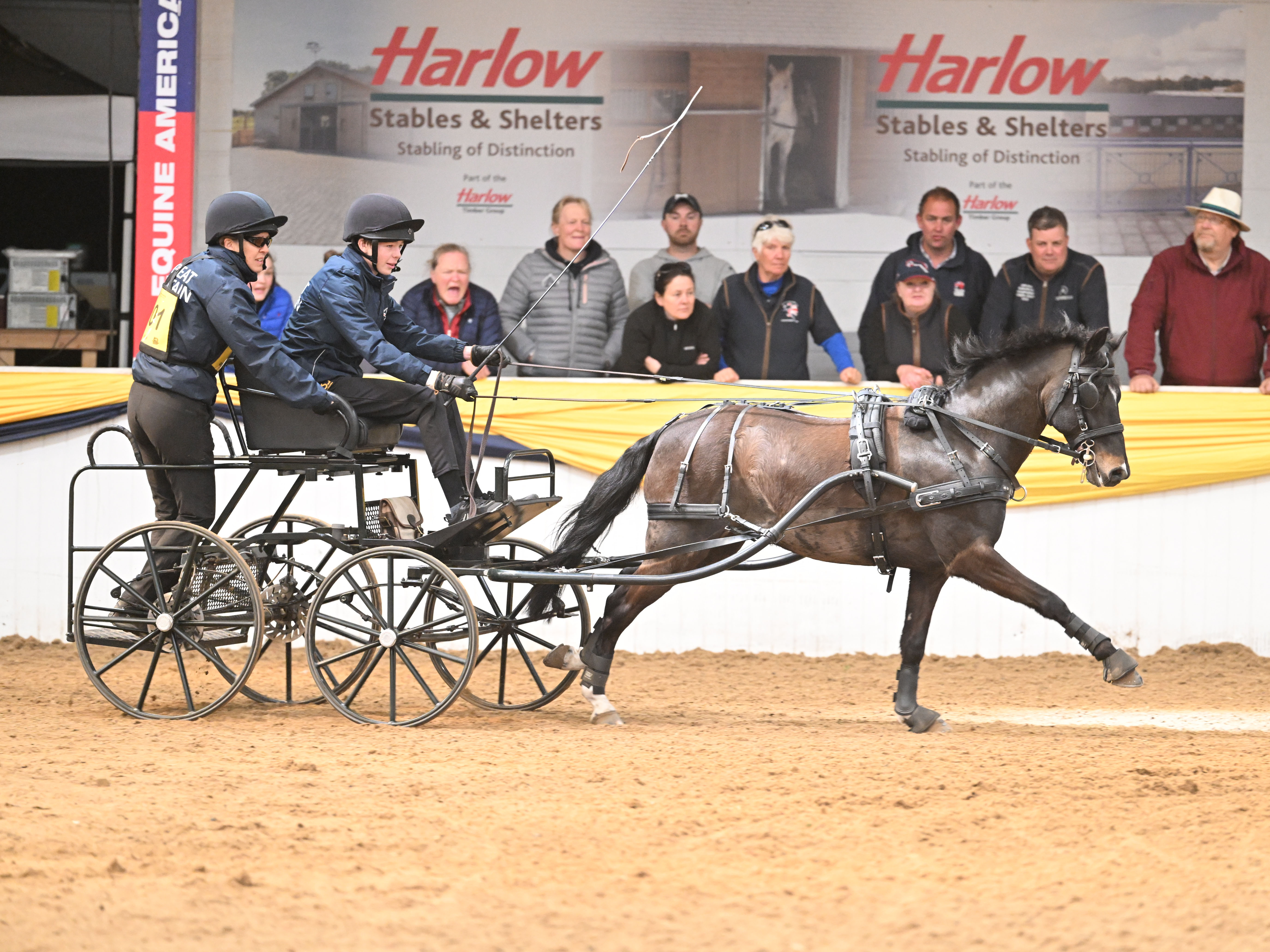
Sophia Routledge is this year’s SUPREME CHAMPION and winner of the Open Pony class. She had just a single time penalty in the cones and the fastest time of the competition in obstacle 1 — in and out in just 32.36 seconds.
Overnight leader Harriet Bradford’s competition-best P&P of 17.25 was crucial in making her Reserve Supreme Champion and 2nd in Open Pony. Sara Howe was catching her fast and ended up just 0.2 penalties behind to take 3rd place in Open Pony. The class was hotly contested with the top six all finishing on a sub-180 score.
Jamie Hordern (pictured) is Novice Junior Champion which will come as no surprise to anyone who has watched him win the Novice qualifier class four times at Merrist Wood this season. Less than two penalties separate second and third with Henry Hyde-Chambers taking reserve over Isla Cooper.
Leslee Wilkinson is Open Horse Champion fastest in obstacle 3, maintaining her overnight lead. Only 0.9 of a penalty behind, John Wilkinson nearly caught up but takes reserve and fastest time in obstacle 4. Wendy Wyatt gains a place on her overnight position to finish in third.
Charlie Parker-King is Pony Pair Champion, building on his cones double clear with some super-fast obstacle times. Charlotte Adams-Lane is the reserve champion, while Rebecca Carrington finishes third.
Tina Ray is Pony Tandem Champion. Charlie Parker-King is fastest in 3 out of 4 obstacles but Tina’s excellent cones made her unassailable. Charlie is reserve.
Angela Smith is Pony Team Champion with a consistent run through the phases. It’s a close run thing with Claire Bourne taking second but finishing less than a penalty ahead of Julie Wedgbury
Steve Hoyle is Veteran Champion, overhauling Lynn Riley with a fast time in obstacle three. Lynn finishes as reserve less than 2 penalties behind Steve.
Viv Foster is Novice Small Pony Champion with Danielle Likeman in 2nd and Samantha Kingdon 3rd in a large and highly competitive class.
Paul D Edwards is Novice Pony Champion with the best final score of the day at 184.87. In the end only a single penalty separated Emily Healey in 2nd and Abbie Fuller in 3rd.
Jessica Downham is Intermediate Small Pony Champion with Anne Horobin only 2 penalties behind in 2nd.
Last year's Novice Pony Champion is this year's Intermediate Pony Champion - congratulations to Hope Nebbeling, fastest of the day in all four obstacles. Emma Michelmore is 2nd and Neat Sharrock 3rd.
A successful defence by Laura Wray to retain Open Small Pony Champion. Kate Cooper finishes 2nd and Sally Rl Edwards
3rd.
Intermediate Sue Baldock is the Combined Horse Champion while Melody Jones is the best of the novices taking Reserve.
Claire Bourne is the new Small Pony Pair Champion, with Samantha Jones finishing less than 4 penalties behind in 2nd. Sarah Daley was 3rd.
Full results here >> < a href="https://www.indoordriving.co.uk/viewresults.php">https://www.indoordriving.co.uk/viewresults.php
More photos from ATG Photography here >> https://atgphotography89.pixieset.com/indoordrivingchampionship2025/ (2025-04-13-18-57-37.txt)
Clarification On How P&p Tests Will Be ...
Clarification on how P&P tests will be judged at the Championships
In response to competitor queries, the President of the Jury of the 2025 National Championships has consulted with the other P&P judges and issued the following clarification on how tests will be judged. [PoJ: Sarah Louise Oxborrow, Ground Jury: Julie Tomasik, Jeffery Ormerod & Caroline Douglas]
Movements 4 & 8 (half circles) precision judging
We understand that there has been some discussion regarding Movements 4 & 8 (Half Circles). For transparency, the precision judges at the Indoor Finals will be assessing the accuracy of these movements based on the placement of the outside wheels of the carriage. This approach will ensure consistency in the judging and will assist competitors correctly execute the half circle while maintaining the required pace for the movement.
Serpentine
Our precision judges will be looking for loops of equal shape, correct use of the arena including accuracy against the markers
Our paces judges will be looking for a consistent rhythm, correct bends , balance and suppleness
Between the loops, you should drive straight across the arena, not on a diagonal
All other movements precision judging
All other movements will be judged on the equine's nose being on the relevant marker and will also take into account the correct use of the arena and the accuracy of reaching the designated markers.
All other movements paces judging
Our paces judges will be looking for smooth clearly defined transitions, maintenance of rhythm, straightness and correct bend. They will also be judging the quality of the paces and acceptance of the equine to the driver’s aids.
All movements paces and precision
As always, our paces and precision judges will evaluate each movement independently, without consideration of any previous or subsequent movement.
Please note that the diagrams provided with the dressage test sheets serve as a visual aid and may not precisely represent the required movement
(2025-03-28-10-08-43.txt)
Drivers With Disabilities ...
DRIVERS WITH DISABILITIES

Ever since it was founded, ICD has welcomed drivers of all abilities and most have been delighted at the prospect of competing on equal terms. This year we're offering a special class but it does not stop qualified drivers competing in other classes as they have done in the past, if that's what they'd prefer to do.
Drivers with disabilities are invited to enter the new class, providing that:
- They are a member of ICD
- They have competed at one regional event this season (at least)
Drivers can have competed in the regional events at any level – novice to open, singles but NOT multiples.
This is not a championship class, meaning that drivers do not have to achieve the 75% qualification criteria to be able to enter.
If you've qualified for another class you have the choice but it is one or the other, not both. Entering the Drivers with Disabilities class prohibits a driver from entering a Championship class.
The competition will be the same for Novices (same P&P, same cones, same obstacles). Competitors in this class will do the Novice P&P test (the same as the qualifier test).
Entry fee is £75
Because it's a new idea and we want to make sure it operates properly, you cannot enter this class using the online system.
If you'd like to be involved, to fine out more or you want to enter please email Julia Crockford (2025-03-09-18-39-37.txt)
Children's Challenge At Arena Uk 11 ...
CHILDREN's CHALLENGE AT ARENA UK 11 APRIL 2025
 It's so cool to see Gen Alphas (born after 2010) at the reins at so many of our regional events. We want to encourage these future champs by giving them a taste of the National Championships at Arena UK in April.
We are therefore running a world cup style competition in the main arena late afternoon of Friday 11 April (after other classes have finished) especially for children
This Children's Challenge is open to anyone between 6 and 14 who:
- Has competed in at least one regional event
- Hasn't qualified for Novice Junior or any other class
- Is a member of ICD
The event is FREE to enter
There will three classes: 6 to 10 years, 11 to 12 years and 13 to 14 years (if there are enough entries - otherwise classes may be merged)
Rosettes down to fourth place
If you'd like to be included, send your name, date of birth and details of at least one regional event you've been to by email to: Kayti Harvey
FAQs
- As per regional events, you will need a competent adult groom
- Yes, your groom may have a second set of reins
- We're hoping to have 2 obstacles with A to D gates and cones between, the course to be driven twice. However, this is subject to change as we work out the logistics when we know numbers
- Yes it really is free but you will have to get there and persuade your competent adult to pay for stabling (if required) and other expenses. We calculate your age as of 1 October 2024.
- If you qualify in another class, even at the last minute, you will compete in the qualifier class not the Children's Challenge.
- Normal ICD rules apply. You and your groom will need to be wearing hard hats and back/body protectors.
- Grooms must be on the carriage even for small ponies.
Children’s Challenge At Arena Uk 11 April 2025
CHILDREN’S CHALLENGE AT ARENA UK 11 APRIL 2025

It’s so cool to see Gen Alphas (born after 2010) at the reins at so many of our regional events. We want to encourage these future champs by giving them a taste of the National Championships at Arena UK in April.
We are therefore running a world cup style competition in the main arena late afternoon of Friday 11 April (after other classes have finished) especially for children.
This Children’s Challenge is open to anyone between 6 and 14 who:
- Has competed in at least one regional event
- Hasn’t qualified for Novice Junior or any other class
- Is a member of ICD
- The event is FREE to enter
- There will three classes: 6 to 10 years, 11 to 12 years and 13 to 14 years (if there are enough entries – otherwise classes may be merged)
- Rosettes down to fourth place
If you’d like to be included, send your name, date of birth and details of at least one regional event you’ve been to by email to:
Email Kayti Harvey
FAQs
- As per regional events, you will need a competent adult groom
- Yes, your groom may have a second set of reins
- We’re hoping to have 2 obstacles with A – D gates and cones between, the course to be driven twice. However, this is subject to change as we work out the logistics when we know numbers.
- Yes it really is free but you will have to get there and persuade your competent adult to pay for stabling (if required) and other expenses.
- We calculate your age as of 1 October 2024.
- If you qualify in another class, even at the last minute, you will compete in the qualifier class not the Children’s Challenge.
- Normal ICD rules apply. You and your groom will need to be wearing hard hats and back/body protectors. Grooms must be on the carriage even for small ponies.
Sponsor Opportunities At The 2025 Championships
Sponsor opportunities at the 2025 Championships
 There are still a number of sponsorship opportunities open for the next championship. Find out more here
(2025-01-12-14-36-19.txt)
Anne Meluish Wins Dick Carey Award
Anne Meluish wins Dick Carey Award
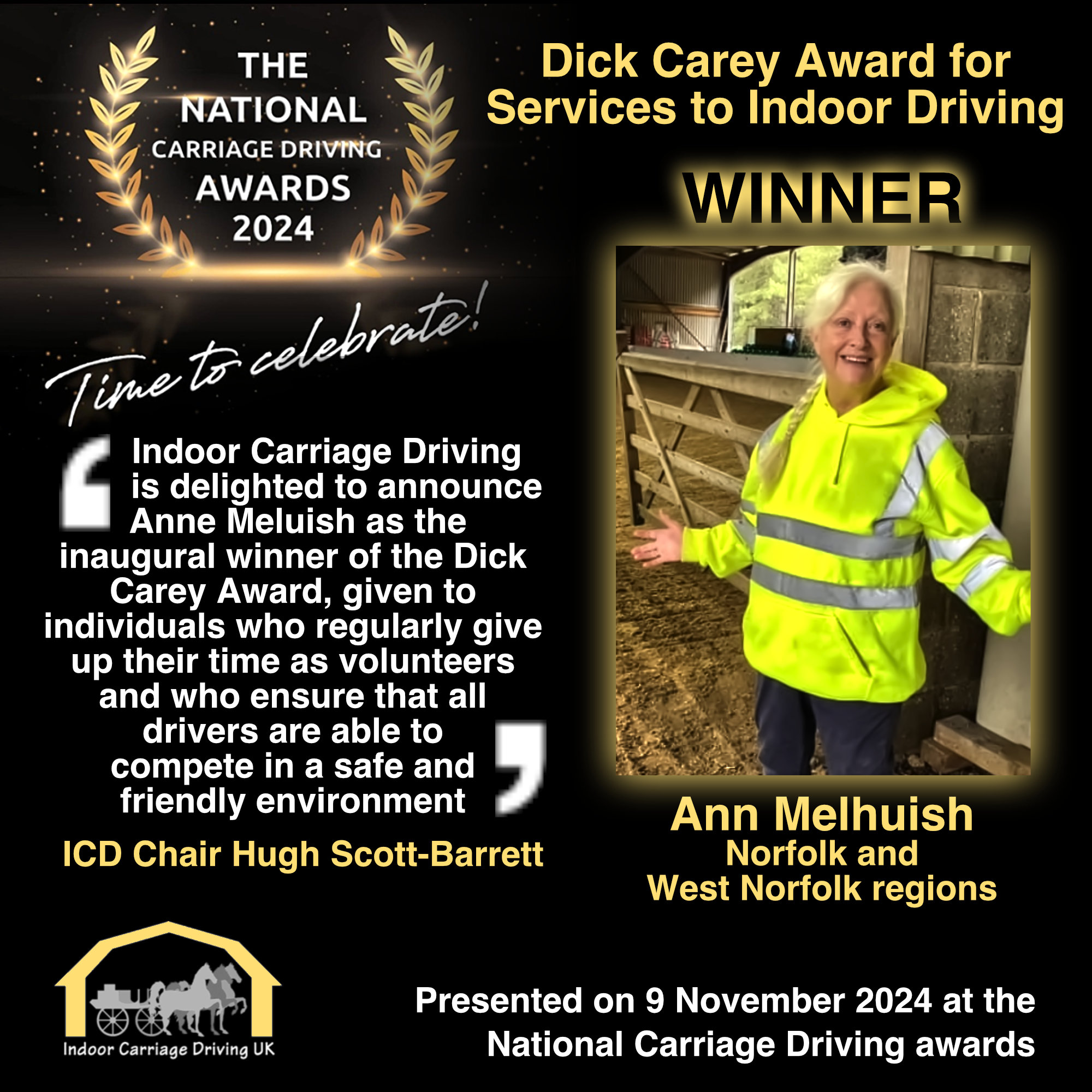
Indoor Carriage Driving is delighted to announce Anne Meluish as the inaugural winner of the Dick Carey Award, given to individuals who regularly give up their time as volunteers and who ensure that all drivers are able to compete in a safe and friendly environment," said ICD Chair Hugh Scott-Barrett. Dick Lane presented the award on 9 November 2024 at the National Carriage Driving awards
It was a tight run thing. Also deserving of congratulations are the other nominees
- Alan Payne Mid Wales
- Ainslie Turner South West
- Dave Crockford Wessex
- Jan Lane South
- Jane Dunsdon Wessex & ICD Championships
- Julian Burleton Thames Valley
- Richard and Lyn Spurgeon East Anglia
(2025-01-12-14-27-10.txt)
Images From The 2024 Championships
Images from the 2024 Championships
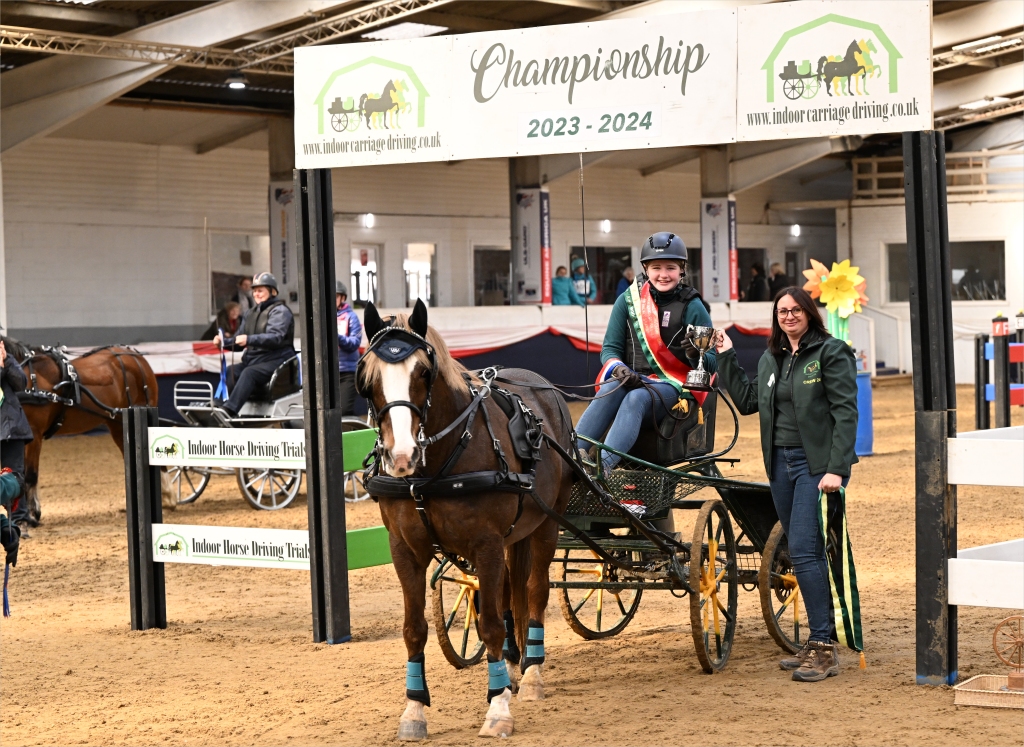
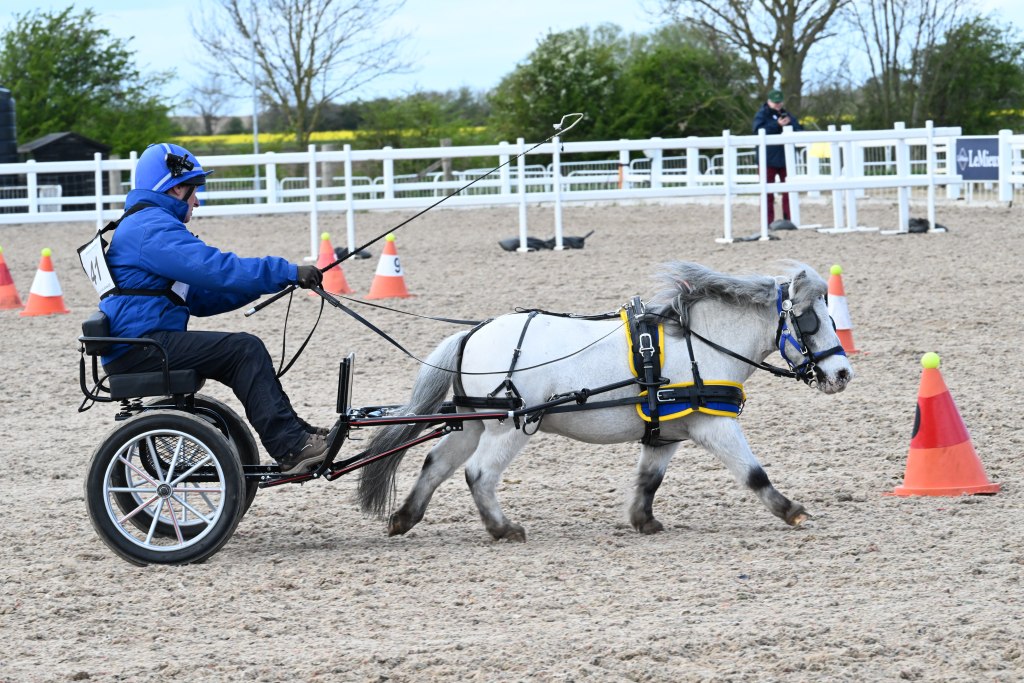
John Woolley Ltd's continuing support for the Supreme Championship Awards at the British Indoor Carriage Driving Championships for the open classes is greatly appreciated and their business manager Tracey Butterworth kindly presented the 2024 Supreme Champion Ruby Gray with her sash and rosettes. Ruby, 14, won the Open Pony Driver class: Reserve Supreme Champion was Lynn Riley, the Veteran Driver Champion. John Woolley Ltd also kindly sponsored the commemorative rosettes received by all the competitors. Image thanks to ATG Photography
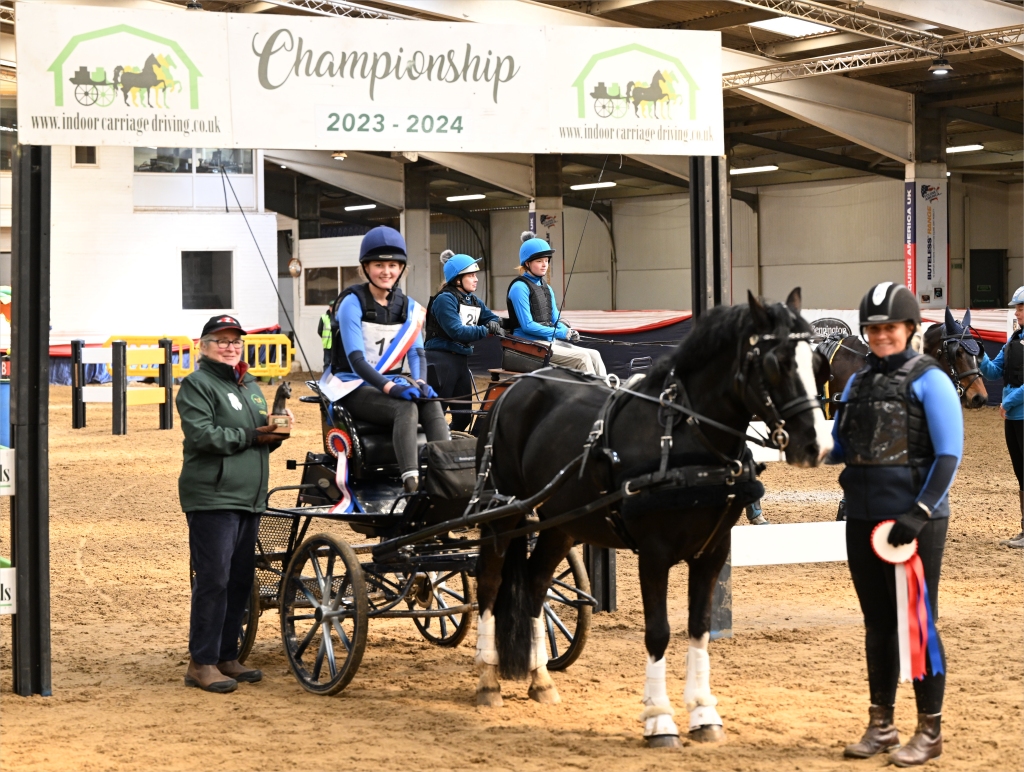
P&S Automation Ltd kindly sponsored the Small Pony Supreme Chamionpship won by Laura Wray, as well as the Reserve Small Pony Supreme Champion. Pictured here is first-timer Anne Horobin, the Novice Small Pony Champion.Image thanks to ATG Photography
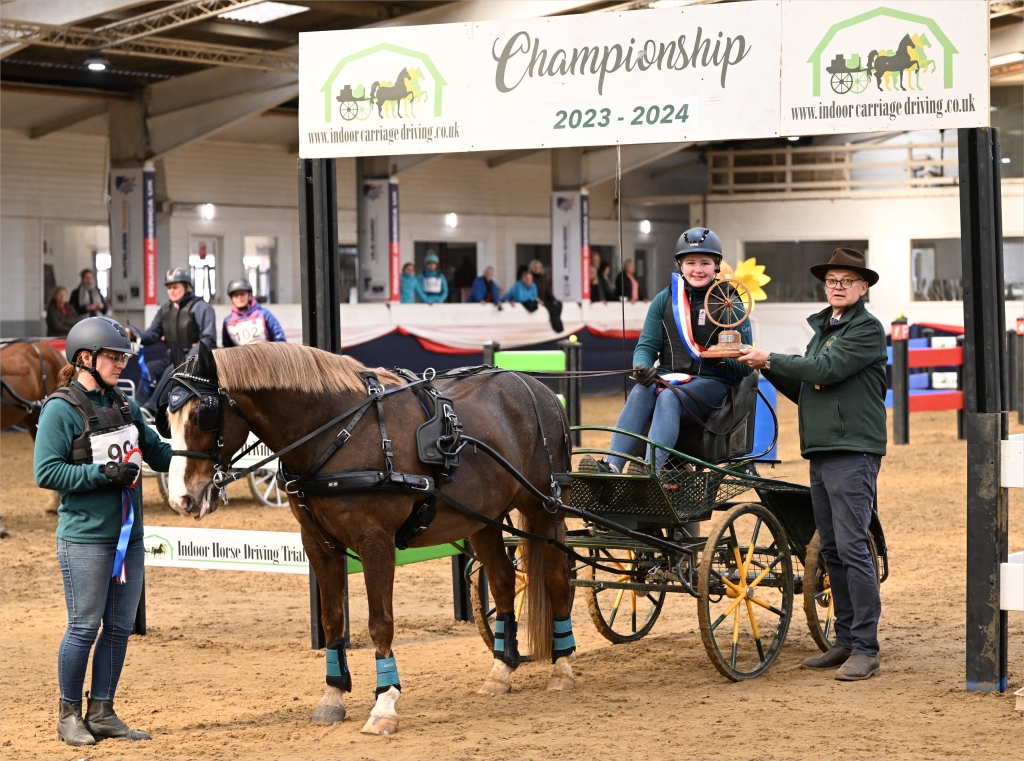
Karen Scott-Barrett's generous sponsorship of the new Overall Intermediate Champion and Reserve Champion was greatly appreciated by the first winner, young driver Izzy Brunner, 15. Frances Collings of Jack in a Box presented Izzy with the Intermediate Pony Driver Champion Award. Image thanks to ATG Photography
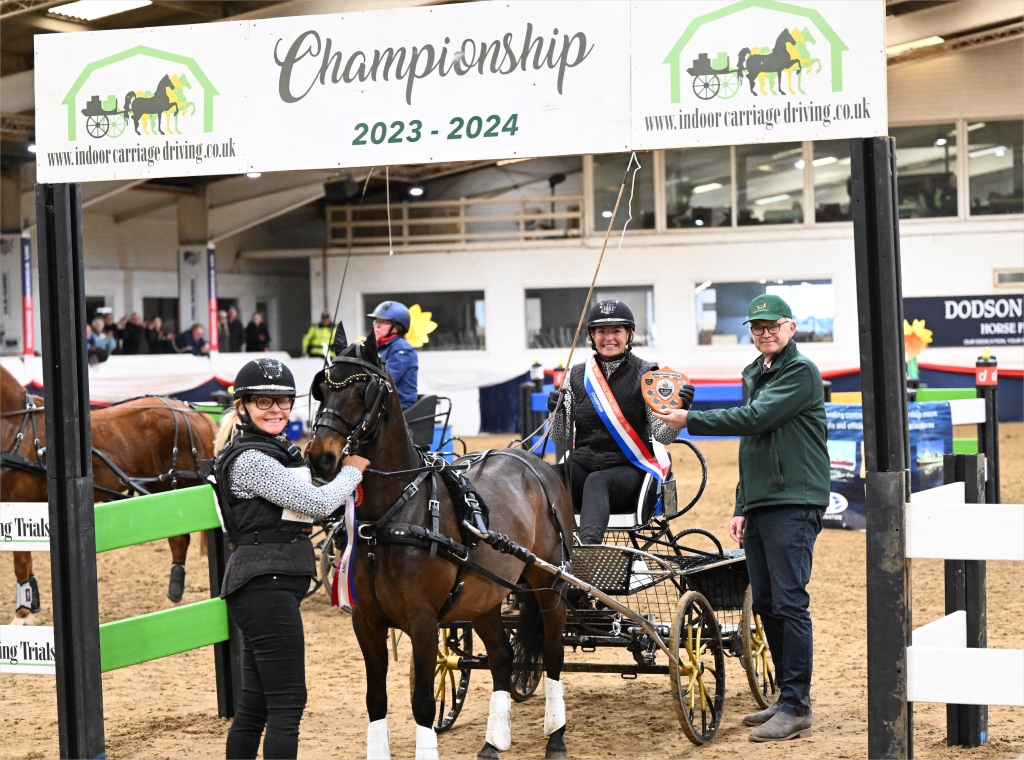
ICD-UK Chairman Hugh Scott-Barrett's energetic fund-raising and leadership have proved to be a game-changer for the British Indoor Carriage Driving Championships. Hugh Scott-Barrett presents the ICD founder's Dick Carey Award to the 2024 Supreme Champion Ruby Gray, 14. Image thanks to ATG Photography
Hope Nebbeling was delighted to receive the new Overall Novice Championship Award, made for the best score in the Novice Pony, Small Pony and Horse classes and generously supported by new sponsor Iceline Ltd. Hugh Scott-Barrett presented the award. Helen Buck, Reserve Champion Novice Pony also took the Overall Reserve title. Image thanks to ATG Photography
Iceline Ltd were also the top sponsor for the Pony Pair class, which was won by Championship first-timer Charlie Parker-King from West Norfolk. Our sponsors are all greatly appreciated: their support enables ICD-UK to have more Championship classes which, in turn, encourages more drivers to take part throughout the season. Hugh Scott-Barrett presents the Snowy Cleaver Award for Pony Pairs to Charlie Parker-King. Image by ATG Photography
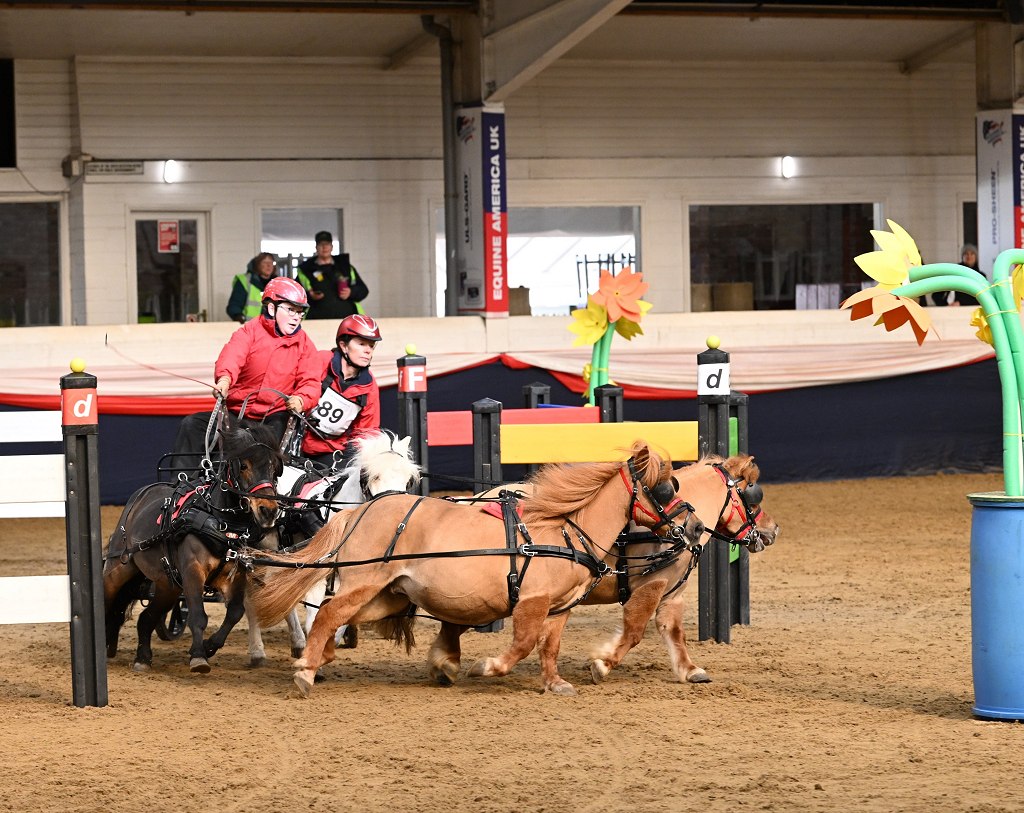
ICD are very grateful to Carriagehouse Insurance for their continued support of the championships and obstacle sponsorship this year. Julie Wedgbury's flies around the obstacles to win the Champion Pony Team title for the 13th time. Image by ATG Photography
(2025-01-12-14-19-25.txt)